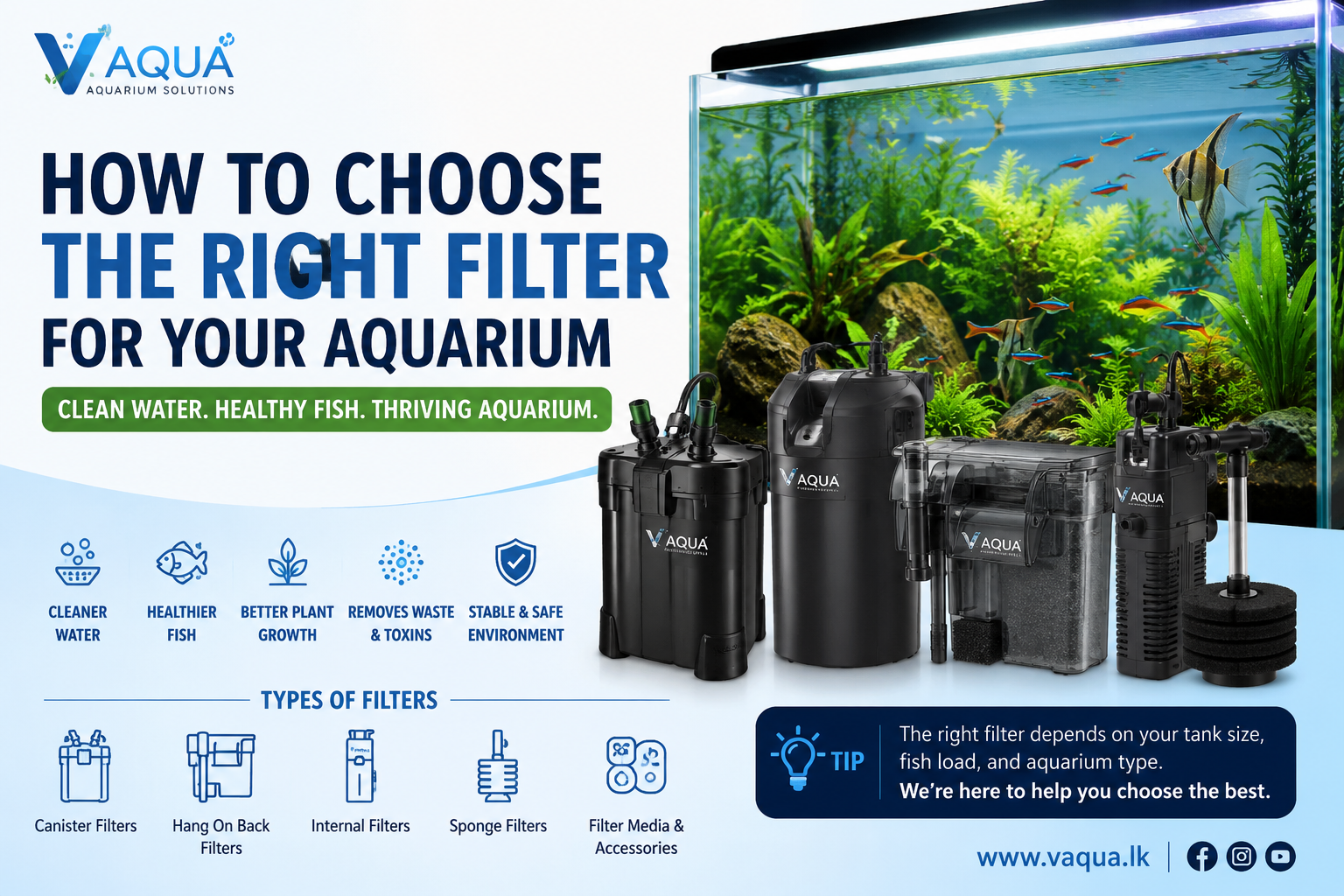
Not sure which filter suits your tank? A simple guide to matching HOB, canister & UV filters to your tank size and bioload — from V Aqua.
A good filter is the single most important piece of equipment in any aquarium. It’s what keeps your water clear, breaks down fish waste, and keeps your fish and plants healthy between water changes. But with so many filter types on the market, it’s easy to end up with something that’s either overkill for a small tank or not powerful enough for a larger one.
Here’s a straightforward guide to picking the right filter, based on the types of filtration we carry at V Aqua.
Start With What a Filter Actually Needs to Do
Every good aquarium filter handles three types of filtration:
- Mechanical filtration – traps debris, leftover food, and floating particles using sponges or filter floss.
- Biological filtration – grows beneficial bacteria that convert toxic ammonia and nitrite into safer nitrate. This is the most important job any filter does.
- Chemical filtration – uses media like activated carbon to remove odors, discoloration, and dissolved impurities.
Most filters combine all three stages, but the type of filter you choose depends mainly on your tank size, what’s living in it, and how much maintenance you want to deal with.
Matching Filter Type to Tank Size
Small tanks and nano setups (up to ~25L)
For nano tanks, bettas, or shrimp setups, a compact hang-on-back (HOB) filter is usually the easiest option. Something like the Marine Blue MB-400DC Mini Hang-On-Back Filter is built specifically for tanks up to 25 liters and still gives you all three filtration stages without taking up much space or overpowering a small tank.
Small to medium tanks (up to ~100L)
This is where most standard hang-on-back filters shine. Filters like the RS Electrical RS-7000 or BOYU WF-2025 are designed for tanks up to 100 liters, offering 3-stage mechanical, chemical, and biological filtration in a slim, easy-to-clean unit that clips onto the back of the tank. HOB filters are a good choice if you want strong filtration without the extra plumbing and space that canister filters need.
Medium to larger tanks (75L–190L+)
If you’re stepping up in tank size or stocking more fish, you’ll want a filter with a higher flow rate and larger media capacity. The Grech CBG-800S Hang-On-Back Filter is built for tanks in the 75–190 liter range, with an adjustable flow rate and a surface skimmer to keep the water surface free of oil films and debris — useful if you notice a filmy layer forming on top of your water.
Large tanks and heavily stocked setups
For bigger tanks, planted aquariums, or setups with a heavier bioload, canister filters are usually the better choice. They sit outside the tank (often underneath it), hold significantly more filter media than a HOB filter, and are much quieter. Canister filters are also the standard choice for pond-adjacent setups — for example, filters like the Boyu EFU series Gardening Bio-Pond Filters are built for 6,000–10,000L ponds and combine auto-cleaning sponge systems, UV sterilizers, and multi-stage bio filtration for much larger volumes of water.
Tanks that need extra water clarity or disease control
If you’re dealing with cloudy water, algae blooms, or want extra protection against parasites and free-floating bacteria, look for filters with a built-in UV sterilizer, like the Grech CBG-800 UV Hang-On-Back Filter. The UV chamber helps neutralize algae spores and harmful microorganisms as water passes through.
Don’t Forget Filter Media
Whichever filter you choose, its performance depends heavily on the media inside it:
- Activated Carbon removes odors, discoloration, and dissolved organic compounds — ideal for keeping water crystal clear, and should be replaced every 4–6 weeks.
- Bio Sponges (like our 8D and 12D High-Density Bio Sponges) provide a large surface area for beneficial bacteria to colonize, boosting your filter’s biological capacity.
- Filter Media Bags make it easy to add extra media — carbon, bio media, or purigen — to canister filters, HOB filters, sumps, or internal chambers without it spilling loose into the filter compartment.
If your filter feels like it’s losing effectiveness over time, it’s often the media that needs attention before the filter itself needs replacing.
Quick Reference
| Tank Size | Recommended Filter Type |
|---|---|
| Up to 25L (nano/shrimp) | Compact HOB filter |
| Up to 100L | Standard HOB filter |
| 75–190L | Higher-capacity HOB filter with skimmer |
| Large tanks / heavy bioload | Canister filter |
| Ponds (6,000L+) | Bio-pond canister filter with UV |
| Cloudy water / disease concerns | UV-integrated HOB or canister filter |
Final Tip
When in doubt, it’s usually better to slightly over-filter than under-filter — a filter rated for a larger tank than yours will simply turn over your water more often, which is rarely a bad thing for water quality. If you’re not sure which filter suits your specific tank and stocking plan, feel free to reach out to us directly — we’re happy to help you match the right filter, media, and accessories to your setup.
Browse our full range of Canister Filters, Hang-On-Back Filters, Internal & External Filters, and Filter Media at V Aqua.